

Smart Tv Thomson Mode D Emploi
You lot tin't use a standard television and wait agile glasses to work. You must have some mode to synchronize the alternating images on the screen with the LCD lenses in the glasses. That'southward where the stereoscopic sync signal connector comes in. It's a standardized connector with three pins that plugs in to a special port on a 3-D-ready television or monitor. The other end of the cable plugs into an IR emitter. The emitter sends signals to your active three-D spectacles. This is what synchronizes the LCD lenses with the action on the screen.
The connector operates using transistor-transistor logic (TTL). One pin on the connector carries low-voltage electricity. A second pivot acts as a ground wire. The third pin carries the stereo sync signal.
There are 2 different types of three-D active glasses and they aren't compatible with 1 another. They are the Eastward-D and ELSA fashion of 3-D glasses. While emitters for both styles work with the stereoscopic sync betoken standard, E-D spectacles volition simply piece of work with an E-D emitter. While a pair of ELSA glasses can synchronize with an E-D emitter, the glasses won't perform properly. For instance, when the E-D emitter sends a signal for the left lens to be transparent, the ELSA spectacles will brand the left lens opaque and cause the right lens to be clear.
Fifty-fifty if you take a 3-D-set tv set, an emitter and a pair of active glasses, not everything on your idiot box volition appear to be three dimensional. Content providers must optimize the bespeak for 3-D first. While it'southward possible to change existing footage into 3-D content, some providers prefer to create video with iii-D in mind beforehand. Currently, the easiest mode to view 3-D content is to connect a computer to your 3-D-ready television using an HDMI cable, and and then stream the three-D content from your computer to your television. In the future, we'll probably meet more than DVD players capable of sending iii-D signals to televisions and possibly even incorporate 3-D transmissions into cable and satellite services.
Lenticular Displays
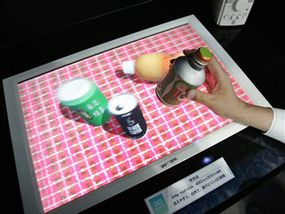
While 3-D technology is impressive, some people still want a solution that doesn't require them to habiliment spectacles. There have been several attempts at creating a display capable of projecting images into a three-dimensional space. Some involve lasers, some project images onto a fine mist or onto artificial fume, just these methods aren't that common or applied.
In that location's one way to create three-dimensional images that you may see in places like sports arenas or in a hotel during a big conference. This method relies on a display coated with a lenticular moving-picture show. Lenticules are tiny lenses on the base side of a special film. The screen displays two sets of the aforementioned prototype. The lenses straight the lite from the images to your eyes — each eye sees only one paradigm. Your brain puts the images together and you interpret it as a iii-dimensional epitome.
This technology requires content providers to create special images for the consequence to work. They must interlace the two sets of images together. If you were to try and view the video feed on a normal screen, you would encounter a blurry double image.
Another problem with lenticular displays is that it depends upon the audience being in a sweet spot to get the 3-D effect. If you were to motion to the left or correct from i of these sweet spots, the paradigm on the screen would begin to mistiness. Once you moved from one sugariness spot to another, the image would return to a cohesive picture. Future televisions may include a camera that tracks your position. The goggle box will be able to arrange the image so that yous're e'er in a sweet spot. Whether this will work for multiple viewers of the aforementioned screen remains to be seen.
Some people experience a feeling similar to motion sickness after watching a lenticular display for more than than a few minutes. That's probably because your optics have to practice actress work equally they bargain with the discrepancy between focus and convergence. But on the other mitt, you don't accept to worry virtually losing an expensive pair of active glasses.
Will 3-D tv set go the next large trend or is information technology destined to be a fad that comes dorsum every couple of decades? Information technology's too early to say right now. But the technology continues to amend. It may not be long before you duck out of the style the next time a baseball player hits a line drive toward the camera.

Smart Tv Thomson Mode D Emploi,
Source: https://electronics.howstuffworks.com/3d-tv.htm
Posted by: jensenharks1998.blogspot.com
0 Response to "Smart Tv Thomson Mode D Emploi"
Post a Comment